

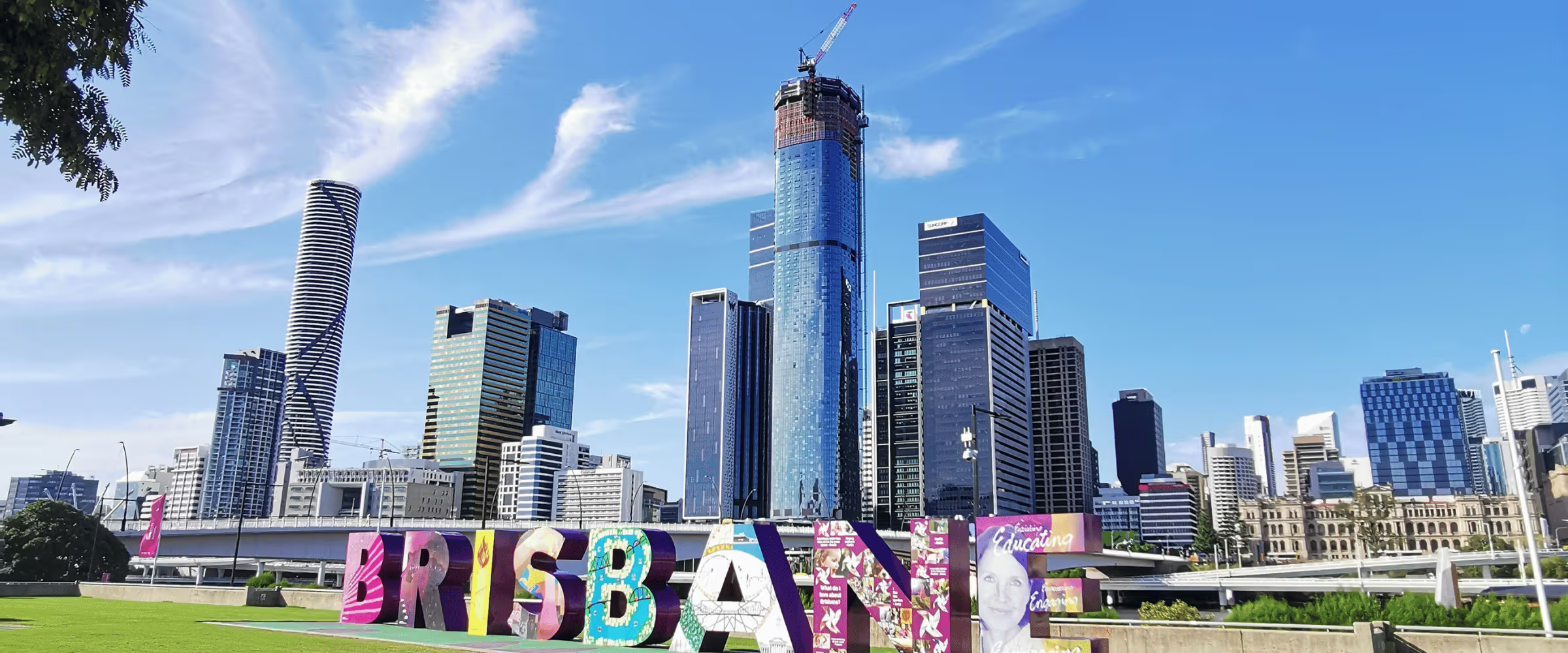
The Brisbane Games will leave a public trail that's bigger than any stadium build, tickets, results, highlights, volunteer stories, local business moments, sponsor activations, and the civic pride that follows them. Most of that record will live online first, shared, searched, linked, and reused by fans, media, schools, and researchers.
Yet the web has a short memory. Official Games sites get retired, deep links break, and the history splits across archives, social platforms, and private collections, so the story becomes harder to verify and harder to find.
That's why the Games need a permanent digital home, a single, trusted address that doesn't vanish when budgets, contracts, or platforms change. An onchain namespace can hold that role, and .brisbane2032 can serve as the stable front door to the full record of the Games, from the first announcement to the last legacy update.
A major Games isn't a single website launch. It's a living record that expands every day, across sport, transport, safety, culture, and community life. Each update creates new pages, new posts, new files, and new references that others reuse.
That growth is exactly why a normal web setup breaks down. Traditional domains change owners, teams change vendors, and campaign sites get retired. Meanwhile, the public keeps searching for answers and receipts. A permanent onchain domain home, anchored in .brisbane2032, gives the Games one stable front door, even as everything behind it evolves.
Games content doesn't come from one publisher, and that's the point. The organizing committee posts official updates and policies. Local councils publish road closures, local venue rules, and community event calendars. Transport authorities push timetables and service alerts. Venues publish entry conditions and bag rules. Broadcasters publish schedules, clips, and athlete features. Teams and national bodies publish selections and training updates. Sponsors run promotions and pop-up locations. Cultural partners promote festivals, exhibitions, and city-wide celebrations.
Now picture what a fan, athlete, or local actually experiences. You open one tab for tickets, another for transport, another for a venue map, then a social post for a last-minute change. Along the way, you bounce between different domains, different writing styles, and different update times. Even when everyone is acting in good faith, the result is messy. The same rule gets paraphrased. The same map gets re-uploaded without context. A link gets shared without the date it was accurate.
This scattered setup also creates two real risks:
Here's a concrete scenario that will feel familiar. A visitor is heading to a venue and needs to confirm an entry rule (for example, whether a small camera is allowed). They find one rule on a venue page, a slightly different rule in a PDF shared by a sponsor activation page, and a social graphic reposted by a volunteer group. Which one is the official source, and which one is outdated? The visitor isn't trying to be difficult, they just want to follow the rules. When links are scattered, certainty becomes a scavenger hunt.
An onchain home changes the structure of the problem. With .brisbane2032, every stakeholder can still publish, but the Games keep one canonical directory of verified destinations, updates, and references that don't drift as vendors and platforms change.
When the official path is obvious, people stop relying on screenshots, reposts, and guesswork.
After the closing ceremony, the internet doesn't pause. People keep looking up results, revisiting stories, and checking what was promised. Yet this is when normal event websites start to fade. Budget lines end. Contracts expire. A redesign happens. A domain redirects to a generic page. A PDF gets moved. Over time, the record fractures.
In plain language, link rot is what happens when a link that used to work stops working, or starts pointing somewhere else. Sometimes the page disappears. Sometimes the domain stays up, but the exact page is gone. Either way, the reference fails, and the public loses a piece of the trail.
This matters because the Games generate assets that people rely on long after the spotlight moves on, including:
When those assets vanish or become hard to verify, the loss isn't sentimental. It becomes a trust problem. If an accessibility guide disappears, people can't confirm what support was offered. If legacy commitments get buried, residents can't easily check delivery against promises. If official results pages redirect, public records become harder to audit.
Past Games have shown how quickly official sites can disappear or get redirected, leaving gaps that archives and fans scramble to patch. Brisbane's answer should be stronger than hoping third parties save snapshots. A permanent onchain domain home makes the public record harder to erase, easier to cite, and simpler to verify.
Because the Queensland Foundation TLDs are onchain, owned by kooky, and powered by freename, .brisbane2032 can serve as the enduring address for official references. That keeps the story intact, not as a scrapbook, but as infrastructure the public can count on.
When people search for the Brisbane Games, they aren't looking for a one-time campaign page. They want the official record, the safest links, and the clearest answers, even years after the flame. That only happens when the Games have one permanent, public-facing name that holds steady as teams, vendors, and platforms change.
An onchain namespace built for the Games gives that stability. It creates a single place where the public can verify what's official, what changed, and where to go next, without guessing which link is real.
Think about the physical sites the Games build and rely on. A stadium isn't designed for one match, it serves decades of events and community use. A library doesn't shut when a project team rotates, it keeps knowledge available, organized, and findable. An onchain domain home works the same way: built once, trusted for the long haul.
A permanent namespace such as .brisbane2032 can act as the Games' public infrastructure layer, because it can point to many kinds of official truth, not just web pages. For example, it can map human-readable names to:
The key benefit is continuity. Organizing teams change, sponsors rotate, and service providers come and go. Still, the namespace remains the steady index, so the public doesn't have to relearn where "official" lives.
A permanent onchain domain home turns official information into a public utility: easy to find, hard to impersonate, and built to outlast the event cycle.
A "digital stadium" isn't a metaphor for a flashy site. It's a practical directory of services people use under pressure, on phones, in crowds, and across time zones. Under .brisbane2032, each subdomain can serve a specific job, with a clear user benefit.
Here's what that can look like in real life:
Put simply, one namespace can hold many doors. People get a consistent place to start, and the Games keep a durable structure for truth, service, and legacy.
A Games this large doesn't just need websites, it needs a public naming system people can recognize at a glance. When millions of fans, families, media teams, schools, and visitors hunt for answers, they move fast and they trust patterns. That's why the strongest legacy asset isn't a single portal or app, it's the namespace that holds every official door under one roof.
.brisbane2032 does that job because it's purpose-built for this moment and this place. It can hold verified services during the event, then keep the record usable long after the closing ceremony. Because the Queensland Foundation TLDs are onchain, owned by kooky, and powered by freename, the name itself can act like civic infrastructure: stable, public, and easy to check.
Scammers win when the public has to guess. Fake ticket sites, spoofed donation drives, and copycat athlete pages all depend on the same weakness: inconsistent naming spread across too many domains, social accounts, and link shorteners. A single namespace fixes the first and most important problem, people can learn one habit and use it everywhere.
With .brisbane2032, the official pattern stays consistent across services, partners, and announcements. Fans don't need deep technical knowledge. They just need to remember that official destinations follow clear rules, and anything outside those rules deserves scrutiny. Think of it like uniforms at a venue. When staff wear the same badge and colors, impostors stand out sooner.
A public protection standard can look simple, but still be strict:
tickets.brisbane2032, transport.brisbane2032, venues.brisbane2032, and partner spaces like partnername.brisbane2032 that only exist after approval.This also protects people who are acting in good faith. Local community groups and volunteer teams can share links confidently when they can point back to a single, known source. Meanwhile, search engines and platforms get a cleaner signal, because the official network of links lives under one namespace.
The safest internet is the one where the official path is obvious, because confusion is where scams breed.
The payoff is practical. A parent buying tickets shouldn't have to compare five sites and guess which one is real. A fan donating to a flood-relief appeal connected to the Games shouldn't wonder if the page is a clone. A consistent .brisbane2032 naming system makes those choices easier, because it replaces guesswork with a repeatable rule.
These Games are designed to spread across Queensland, with events and programs reaching beyond Brisbane into the Gold Coast, Sunshine Coast, Cairns, Toowoomba, and other host locations. That scale is a strength, but it also creates a coordination problem online. Without one namespace, every region ends up running its own set of domains, each competing for attention, search rank, and trust.
.brisbane2032 solves that by giving every place and program a home without forcing them into a branding tug-of-war. Instead of splitting into separate web identities, each region can sit inside a shared structure that feels familiar to the public.
Picture a visitor planning a trip with events in multiple cities. They want venue rules, transport updates, accessibility support, and local guides. If each city publishes under unrelated domains, the visitor starts over every time. Under one namespace, the experience stays coherent:
This shared model matters even more for people, not just places. Athletes and Para athletes need a safe way to point fans to real profiles, appearances, and fundraising channels. Volunteers need proof of service that still works later. Schools need educational resources that remain findable year after year. Local organizations need a reliable identity for cultural programs and community celebrations that surround the competition.
A namespace can support all of that with consistent identities and credentials. For example, an athlete's official page and verified links can live under an athlete directory inside .brisbane2032, while their participation credentials can be validated through the same trusted naming system. Volunteers can share a single verification link that confirms role and status without exposing private details. Schools can cite official learning packs with stable addresses that don't vanish when a project site gets retired.
Most importantly, a shared namespace keeps Queensland's story intact. Instead of a patchwork of disconnected pages, the Games leave one navigable record, connecting elite sport with grassroots programs, regional hosts, and the civic work that makes the event possible. When the public asks, "Where's the official source for this?", the answer should be simple every time: start at .brisbane2032.
The Games will create a massive online record, from live updates and venue rules to results, accessibility guides, and legacy reporting. Yet regular websites fade, links break, and official information spreads across too many places, which also makes scams easier. A permanent onchain namespace solves this by giving the public one trusted front door that stays put while platforms and vendors change, with .brisbane2032 as the durable address for services, stories, and verifiable public records.
If Brisbane's leaders want digital systems that last, the simplest move is also the strongest: commit to one official namespace, set naming rules early, and treat the digital home as core infrastructure, not a campaign site. Organizers, councils, and partners can start by agreeing on the canonical directory under .brisbane2032, then publishing every critical service through that structure, so people always know where "official" lives. Thanks for reading, what would it look like if the most enduring legacy of the Games was a public record no one could misplace?

Queensland Foundation has secured the TLDs that belong to Queensland. Claim yours - once, forever.